The AI-Native Engineering Org & Operating Model
Introduction
For the last several decades, software organizations have been built around a single, undeniable constraint: writing and deploying syntax is a slow, manual bottleneck. Nearly every operating model we celebrate was an attempt to break down organizational silos, an optimization within that constraint rather than an escape from it. Amazon’s two-pizza teams attacked communication overhead to force cross-functional ownership. Google’s SRE discipline rewrote the contract between the people who build software and the people who run it. The DevOps movement tore down the wall between development and operations, compressing the path from commit to production. Each was a genuine advance, and each quietly accepted the same premise: that hand-written human code is the atomic unit of output, so the organization must be shaped to move that work through people as efficiently as possible.
The rapid advances in generative AI offer a revolutionary escape from this constraint, but most enterprises are wasting the opportunity on a half-measure: pasting AI assistants and tools into the same legacy structure and processes. They buy thousands of licenses, watch individual developers pick up a 20% coding speedup, and then wonder why their overall time-to-market has not budged or even worse, quality has decreased. The reason is simple: they are optimizing for localized efficiency inside an isolated engineering silo. The generated code still sits in the same PR queues and still chokes on the same deployment pipelines. True effectiveness is a different goal. It means breaking the linear tax that has governed software for two decades: the rule that more features demand more people, more management layers, and more hand-offs between Business, Tech, and Ops. AI is not a tool for making the engineering silo faster; used well, it is the solvent that melts the walls between those silos. These advances are not a better autocomplete; they are an opportunity to evolve how software gets built end to end, not merely how it gets written. AI does not just make the old bottleneck faster; it dissolves it entirely, and the constraint moves. It is no longer about generating syntax. The new constraints are system architecture, enterprise context ingestion (the “Enterprise Brain,” an internal RAGRetrieval-Augmented Generation. The model is handed relevant snippets pulled from your own documents and code at query time, so its answers stay grounded in your enterprise’s facts rather than only its training data. over your codebase and documentation), and deterministic guardrails. The answer, then, is not another optimization layered onto the existing model. For the first time in decades, the shape of the organization itself has to fundamentally change.
This is also where the productivity-only framing falls apart. Done pragmatically, rewiring the operating model is not just about shipping faster. The very same agentic infrastructure that compresses cycle time (automated reviews, deterministic guardrails, enforced test pyramids, and continuous security auditing) simultaneously raises the floor on quality and security. Speed and rigor stop being a trade-off and start compounding together.
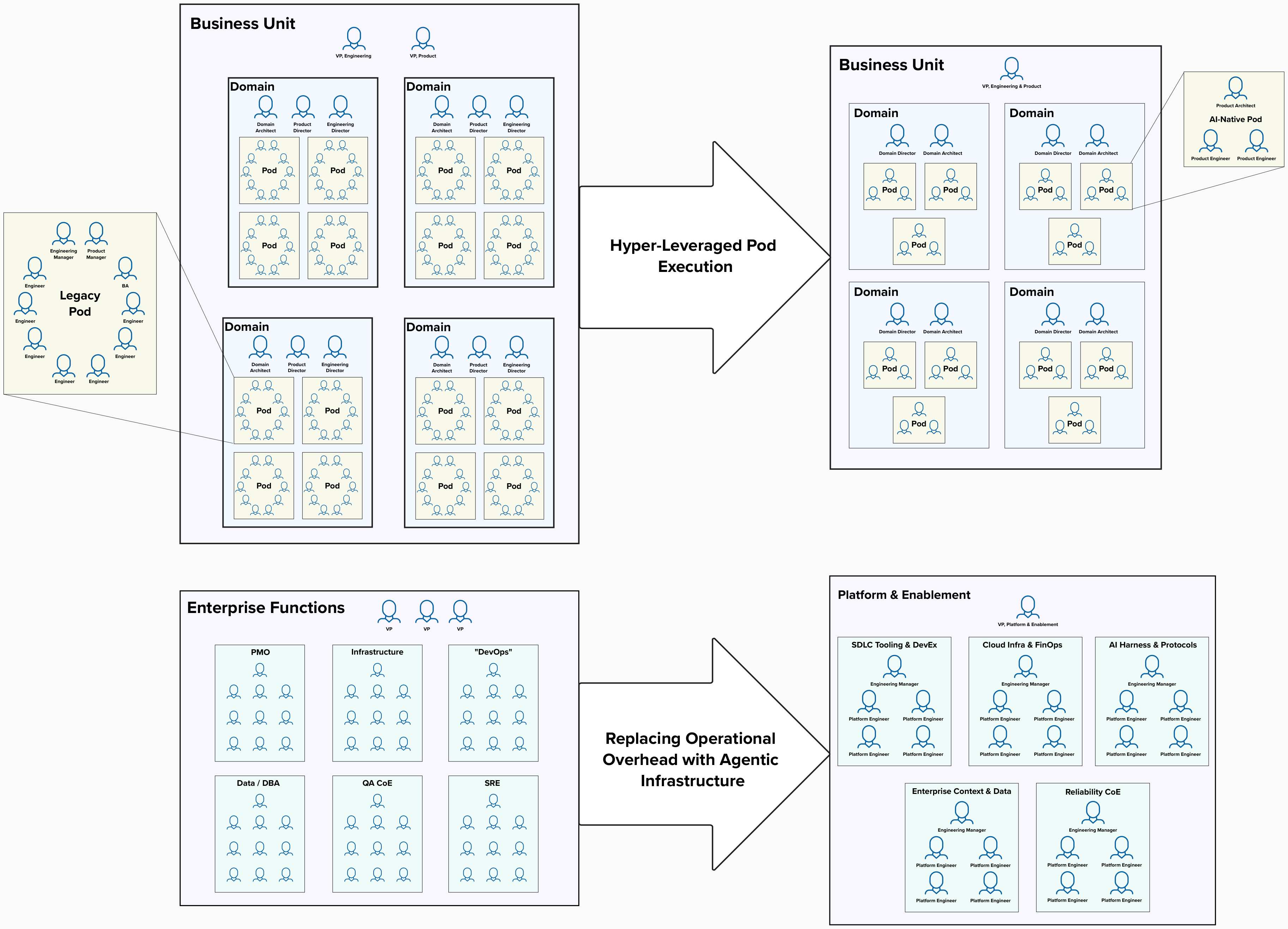
To achieve true capital efficiency, the enterprise operating model must be fundamentally rewired. The goal is no longer human scale; it is talent density and per-capita leverage. This article is the execution blueprint, illustrated in the target operating model below, for compressing your delivery footprint, automating operational overhead, and transitioning to a true AI-Native Engineering Organization.
Key Concepts
1. The Structural Shift: Compressing the Footprint
As illustrated in the target operating model above, the transformation requires decoupling the execution of business logic from the operational foundation that supports it.
The Execution Layer: Increased Leverage Per Engineer
In a legacy model, a standard delivery pod requires a bloated matrix of around 10 to 12 people: an Engineering Manager, a Product Manager, a Business Analyst, Quality Assurance, and a large pool of specialized engineers (frontend, backend, database). The communication tax and hand-offs within this group severely drag velocity.
In the AI-Native model, this matrix is compressed into a hyper-leveraged, 3-person triad:
- 1x Product Architect: Owns the overall product vision and merges the traditional PM and EM roles. Deeply technical but customer-obsessed, they partner with AI to author the epic-level specifications, define system constraints, and set the prioritization that the engineers execute against. This role does not collapse under administrative overhead. Because project tracking and dependency management are handled by agentic ingestion (the governance layer stood up in Phase 4 of the roadmap), the Product Architect is freed from the PMO tax to focus purely on high-level system architecture and rigorous specification design. In effect, this role is the full realization of the cross-functional ideal those earlier silo-busting movements reached for but could never quite achieve under administrative drag. The Business-Tech boundary is collapsed into a single, customer-aligned conductor moving at the speed of the market rather than the speed of hand-offs.
- 2x Product Engineers: Ultra-generalists who act as engineering conductors, directing a network of agentic peers to execute full-stack work. Their core interface shifts from writing syntax line-by-line to managing an agentic workspace. Their day is split between declaring high-level engineering intent, reviewing generated architecture, and guaranteeing end-to-end quality, security, and performance. They don’t spend their hours fighting compiler errors; they spend them orchestrating automated execution, owning complex integrations, and driving adversarial validation to ensure the software remains resilient and maintainable.
At first glance this model appears to be a headcount reduction, but that is the least interesting part. The real bet is on compressed cycle time and compounding output per pod, driven by agentic speed and the systematic liquidation of the legacy pod’s exponential communication tax.
The Domain Leadership Layer: Flattening the Org Chart
Compressing delivery pods into 3-person triads does not just alter execution velocity; it fundamentally rewires the reporting hierarchy. In a traditional enterprise, management is deeply layered: engineers report to an Engineering Manager at the pod level, who reports to a Software Engineering Director, who reports to a Business Unit VP. This creates an administrative telephone game where context is lost and political alignment eats up engineering cycles.
The AI-Native model aggressively flattens this structure by eliminating the pod-level manager entirely. Because administrative drag is automated, a single Domain Director can directly oversee all execution pods within their business capability.
This flatter organization introduces two critical leadership roles that orchestrate the domain:
- Domain Director: Replacing the legacy middle-management stack, the Domain Director owns the operational health, macro-strategic vision, and end-to-end talent management for an entire capability. Because they are freed from the administrative drag of traditional layered reporting lines, their focus shifts from chasing status updates to defining long-term domain direction, identifying and recruiting top systems-thinking talent, and optimizing per-capita allocation across pods. They are the ultimate stewards of the domain’s talent density, ensuring teams are unblocked and strictly aligned with business-critical outcomes.
- Domain Architect: While the pods move fast, someone must ensure they are not building localized silos that fracture the macro-system. The Domain Architect owns the cross-pod technical strategy, API boundary definitions, and long-term evolutionary architecture of the domain. They do not write business logic; they design the systemic constraints and guardrails that let the individual pods move safely at full speed.
The Structural Advantage: By removing a full tier of middle management, the organization gains immense structural agility. Decision-making loops compress from weeks to minutes, corporate strategy is communicated directly to the people writing specifications, and engineering leadership stays intimately connected to the actual product.
The Platform Layer: Replacing Operational Overhead with Agentic Infrastructure
You cannot shrink the execution layer if those lean pods are bogged down by infrastructure tickets, manual release processes, and data silos. The legacy “Enterprise Functions” (PMO, manual Infrastructure, monolithic QA, and Tier 1 Support) must be transformed into a centralized Platform & Enablement Organization.
This platform acts as the automated foundation:
- SDLC Tooling & DevEx: Automated PR reviews, linting, and security checks executed by agents before a human ever intervenes.
- Cloud Infra & FinOps: Infrastructure as Code paired with hard, protocol-level token constraints to prevent runaway agentic costs.
- AI Harness & Protocols: The core team maintaining the custom execution environments, agent protocols, and deterministic guardrails.
- Enterprise Brain: This is not a one-time project. A live, dependency-aware context layer over a sprawling enterprise codebase is the single hardest engineering problem in the entire model, and it is precisely where most corporate AI initiatives struggle at scale. Treat it as the central operational risk and the core dependency of the entire safety case: every guardrail, every adversarial test, every auto-merge decision is only as trustworthy as the context the Brain feeds the agents. The Platform team builds the foundational architecture, a context layer that maps system dependencies, ownership, and architectural boundaries rather than a basic semantic search, so an agent always knows what its change will touch downstream. But the Brain is never “done.” It is an intrinsic, living feedback loop: every execution pod continuously contributes telemetry, schemas, and freshly-shipped context back into it as they merge code, compounding its fidelity over time. The day you treat the Brain as static infrastructure is the day its accuracy starts to rot out from under your agents.
- Reliability CoE (Chaos & SRE): In an AI-Native model, SREs stop being firefighters tethered to a pager and become toolsmiths. They build autonomous agents that continuously break and heal the staging and production environments, injecting failure on purpose and executing automated remediation runbooks, so resilience is proven by relentless attack rather than discovered during an outage.
2. The Operational Protocols: The Engineering Friction Engine
A 3-person triad out-shipping a 10-person matrix sounds reckless until you see the machine underneath it. Talent density alone does not produce enterprise-grade software; the protocols that govern how the triad and its agents work together do. These are the day-to-day mechanics that let a tiny team move fast without surrendering rigor. I call this a friction engine because it deliberately injects friction (tests, small diffs, human checkpoints) exactly where friction raises quality, and strips it out everywhere else.
Adversarial Test-Driven Development
In an AI-Native pod, the human rarely writes the implementation. They write the adversarial tests: the edge cases, the failure modes, the boundary conditions, and the contracts the code must honor. The coding agent’s job is to produce an implementation that turns that suite green. This inverts the classic TDD loop into a specification weapon. The engineer’s leverage now lives in defining what “correct” means under hostile conditions. Crucially, this requires anchoring the agent’s context pipeline within the Enterprise Brain before generation begins. If an agent builds an implementation using only public internet slurry or standard LLM baselines, it produces functional slop: code that compiles but breaks down under your unique system constraints, scale, or compliance parameters. The adversarial suite must therefore be coupled with strict, injected proprietary schemas, API boundaries, and domain-specific mock data, forcing the agent to build on concrete organizational reality rather than generic code patterns. The agent then iterates until every case passes, and the suite becomes the executable definition of done, authored by the humans who understand the domain risk rather than by the agent being evaluated against it.
Short-Lived Feature Branches and Micro-PRs
Agentic velocity creates a new failure mode: large, fast-moving diffs that are impossible to review and that collide violently at merge time. The protocol is the opposite of the long-lived feature branch. Agents ship continuous, tiny, atomic pull requests against a trunk that is always releasable. Each PR does one thing, passes the full harness, and merges in hours rather than weeks. Small diffs keep human review tractable, keep the merge surface minimal, and let the pod integrate dozens of agent contributions a day without the integration debt that sinks large-batch workflows.
That cadence only works on top of an automated quality pipeline that runs before any human looks at the diff: encoded guardrails, linting, a healthy test pyramid, enforced CRAP and maintainability baselines, and mutation testing, all of which also keep each micro-PR simple and scannable rather than a wall of over-engineered cleverness. I cover that pipeline in depth in Avoiding AI Slop, so I will not repeat it here. What matters for the operating model is that this gate is the precondition for the human review below: by the time a person is asked to weigh in, the machine has already proven the code runs, passes, and reads cleanly.
The “Two-Key” Human Review
Autonomy without checkpoints is how agents ship plausible-looking disasters. The Two-Key protocol defines, explicitly and in advance, where a human signature is mandatory and where an agent may auto-merge. A low-risk, well-tested change inside a bounded module (a passing micro-PR that touches no public contract, schema, or security boundary) can merge on the agent’s key alone. Anything that crosses an architectural boundary, alters a public API or data schema, touches auth or security-relevant code, or modifies the guardrails themselves demands a second key: a human turn. Crucially, that line is encoded in the harness, not left to individual discretion, so the boundary between “an agent can ship this” and “a human must look” stays deterministic instead of cultural.
What auto-merge does not do is dissolve accountability. An agent cannot sit in a post-mortem, cannot be paged at 3 a.m., and cannot answer to a regulator. So the accountability chain is explicit and unbroken: the Product Architect and Engineers retain ultimate runtime ownership and systemic accountability for their domains, regardless of whether a human or an agent turned the key on any individual PR. Delegating the merge decision is not delegating the consequences. An auto-merge that causes a production incident is the owning engineer’s incident; the harness simply compresses how many low-risk decisions a human has to personally adjudicate, not who is answerable when something breaks.
Crucially, the human key is preceded by an adversarial secondary model review. Before a person ever looks at a high-risk diff, the harness routes the PR to an independent, specialized frontier model explicitly prompted to play the role of a hostile principal engineer (utilizing deep evaluation capabilities like Claude’s /ultrareview framework). This secondary pass doesn’t just check if the code runs; it actively looks for subtle hallucinated dependencies, security anti-patterns, and architectural drifts.
When a human finally turns the second key, the automated pipeline and the secondary critic have already proven the code runs, passes, and adheres to structural boundaries. Humans are thus entirely freed from hunting for basic execution errors. This is where an intelligent human stays in the loop, applying the judgment the gates cannot encode. They read the change the way a senior engineer reviews a trusted colleague’s work: Does this fit our broader system design and domain intent? Does it introduce subtle coupling or technical debt the tests would not surface? Is there a simpler, more durable approach worth a second pass? The agent is a fast and genuinely capable draft engine, and the human’s role is to contribute the architectural taste, business context, and long-term stewardship that keep the codebase coherent as it scales. The goal is not a reviewer rubber-stamping diffs, nor a bottleneck second-guessing every line, but expert human judgment deliberately spent where it compounds.
Together these protocols are what let a skeptical CTO hand a 3-person pod a production system: human-authored adversarial tests, diffs small enough to reason about, and a hard, encoded line for where human judgment is non-negotiable.
3. The Transformation Roadmap: The Lighthouse Strategy
You cannot flip a switch and turn a 250-person traditional enterprise into an AI-native organization overnight. Attempting a sweeping, top-down restructure will paralyze delivery and create immediate cultural resistance. Instead, the transition requires a methodical, sequenced rollout centered on building the underlying platform layer and scaling via focused Lighthouse Pods.
This transition directly maps to the progressive capability levels outlined in A Roadmap to an Agentic SDLC, aligning your organizational layout with your technical maturity. Each phase below is gated by a capability milestone rather than a date on a calendar: you advance only when the prior phase is genuinely live, not when a quarter ends.
Phase 1: Pour the Foundation
Before altering how product teams execute, you must construct the automated platform layer that catches them. Changing team structures without an underlying engineering harness will only produce chaotic deployment failures.
- Establish platform leadership: Formally appoint the VP of Platform & Enablement and staff the initial core platform pods (AI Harness, SDLC Tooling, and Cloud Infra).
- Deploy the baselines: Standardize the agentic tools, environments and initial harness.
- Enforce FinOps controls: Implement token budgeting and rate-limiting protocols so agentic experimentation cannot create runaway compute costs.
- SDLC alignment: This phase stands up the paved road and the first layer of augmentation, equivalent to Levels 1 and 2 (Paved Road and AI-Augmented) of the Agentic SDLC Roadmap, that make small-scale execution safe.
Gate to advance: The platform pods are staffed, the standard agentic environment and baseline guardrails are live, and FinOps controls are enforced in the network layer.
Phase 2: Spin Up the Lighthouse Pods
Do not force an unproven model onto established product lines. Instead, carve out a greenfield feature, a non-critical microservice, or a distinct vertical capability to serve as your testing ground.
- Form the triads: Select your highest-leverage systems thinkers to form two to three initial pods, each in the 1 Product Architect plus 2 Product Engineer configuration.
- Insulate the teams: Completely decouple these pods from traditional PMO standups, matrixed reporting lines, and ticket-driven hand-offs. They operate purely under the new Engineering Friction Engine protocols.
- Hyper-focused enablement: Treat these initial triads as an elite vanguard. Provide them with immersive training and support as well as immediate, low-latency loops to clear workspace friction. This allows them to focus entirely on establishing patterns for prompt architecture, agentic orchestration, and adversarial testing workflows.
- Establish the foundation feedback loop: Implement a tight, continuous feedback loop between the lighthouse triads and the Platform & Enablement organization. The triads don’t just consume the platform; they actively stress-test it, feeding real-world telemetry, edge cases, and custom harness requirements directly back to the platform pods to iterate on the “Enterprise Brain.”
- Prove the value metric: Document cycle times, deployment frequency, defect rates, and per-capita output. This localized data forms the empirical business case and builds the cultural momentum needed to scale.
Gate to advance: the Lighthouse Pods show a clear, documented improvement in cycle time and per-capita output without a regression in quality, giving you the empirical mandate to expand.
Phase 3: Scale the Domains
With the Lighthouse model validated, begin transitioning the rest of your traditional business units sequentially, domain by domain.
- Evolve middle management: Identify your strongest engineering managers and architects and elevate them into the newly defined Domain Director and Domain Architect roles.
- Flatten the topology: Methodically dissolve the traditional pod hierarchies within the target domain, compressing the remaining engineering footprint into the 3-person triad structure.
- Reallocate leverage: As the execution footprint compresses, elite engineering capacity is aggressively reallocated and upskilled into the centralized Platform & Enablement organization to build out the Enterprise Brain and the proactive Reliability CoE.
- SDLC alignment: This represents agents owning real work across an entire business capability, equivalent to Levels 3 and 4 (Agentic Tasks and Autonomous Subsystems) of the Agentic SDLC Roadmap, and it requires deep contextual integration.
Gate to advance: at least one full domain is running on the triad topology under the new leadership roles, with the Enterprise Brain serving it real, accurate context.
Phase 4: Automate Enterprise Scale
With the execution pods running seamlessly on top of a mature platform layer, you can eliminate the final operational bottlenecks that live outside the code repository.
- Deploy agentic ingestion: Transition project tracking and delivery metrics from manual entry to autonomous ingestion. Deploy monitoring agents that parse commits, pull requests, architectural specifications, and communication channels to dynamically generate dependency maps and executive dashboards.
- Achieve autonomous resilience: Transition the SRE discipline fully into the Reliability CoE, moving from reactive pager-duty to continuous, agent-driven chaos engineering.
- SDLC alignment: This fulfills the multi-agent ecosystem described as Level 5 (Agentic Ecosystem) of the Agentic SDLC Roadmap, where the system approaches true self-optimization.
Conclusion
The transition to an AI-Native operating model is fundamentally not a cost-cutting exercise; it is an output-multiplying strategy.
For the past two decades, scaling an engineering organization meant accepting a linear tax: more features required more developers, which created more management layers, which ultimately dragged down velocity. Paste-on AI assistants do not break this cycle; they just accelerate the generation of the very code that chokes your existing pipelines.
True capital efficiency requires treating AI as an organizational solvent. By replacing traditional operational overhead with an agentic platform foundation and concentrating senior talent into dense, autonomous triads, you change the math entirely. The trade-off between velocity and governance does not disappear, but it is more systematically managed and dramatically compressed.
The result is an enterprise that operates with the radical agility of a seed-stage startup, structurally protected by the deterministic stability and systemic rigor of a Fortune 500 company. The competitive chasm over the next decade will not be between those who use AI and those who do not. It will be between organizations built to human scale and those engineered for agentic leverage.
A final note of humility. This is genuinely new territory, for me as much as for everyone else in the industry. Nobody has run this exact playbook at enterprise scale yet, and I fully expect my own thinking to evolve as I put more of it into practice and learn from people doing the same. Treat this less as finished doctrine and more as a working hypothesis. I will keep sharing what holds up, what I get wrong, and how the model changes in future posts here.